How to Choose the Right Heating Element Wire for Your Project?
Selecting the right Heating Element Wire is crucial for project success. According to the latest industry reports, nearly 70% of electrical failures are linked to improper heating elements. This statistic highlights the importance of making informed choices when choosing materials for thermal applications.
Heating Element Wire comes in various alloys, each with distinct properties. Common materials include nichrome, Kanthal, and copper. Nichrome is often favored for its durability and stable temperature resistance. However, it may not be the best option for every application. For instance, copper offers excellent conductivity but has a lower melting point.
Choosing the best wire requires a clear understanding of your project’s specific needs. Factors like temperature range, resistance, and application type must all be considered. Evaluating these details can prevent costly mistakes later on. Remember, the right Heating Element Wire contributes to both efficiency and safety in your project.

Understanding Heating Element Wire Types: An Overview
When selecting heating element wire, various types must be understood. The wire material affects performance. Common materials include Kanthal, nichrome, and copper. Each type has unique properties that suit different applications.
Kanthal is excellent for high temperatures but can be difficult to work with. Nichrome is popular for its ease of use and stability. Copper offers good conductivity but may not withstand high temperatures as effectively. These characteristics matter depending on your project's needs.
Consider the wire gauge as well. A thicker wire can handle more power but may heat slowly. A finer gauge provides quick heating but can burn out easily. Experience in materials and their limits teaches valuable lessons. Experimentation is key. Choose wisely to avoid mistakes. Understanding these details helps ensure your project's success.
Heating Element Wire Types Comparison
Key Specifications to Consider When Selecting Heating Element Wire
When selecting a heating element wire for your project, several key specifications are crucial.
Start with the wire material. Common options include nickel-chromium and iron-chromium alloys.
Each has specific resistance and heat characteristics. Be sure to consider the maximum operating temperature.
Different applications require varying tolerances. This factor directly impacts the wire's longevity and performance.
Consider the wire gauge as well. A thicker wire may handle higher currents but could take longer to heat up.
Conversely, a thinner wire heats quickly but may not sustain high temperatures.
It’s essential to analyze your project’s demands.
Tips for selection include calculating the power requirements. Ensure you know the voltage and wattage needed.
Proper insulation is another vital aspect. Insulation affects efficiency and safety.
Check if the wire can withstand environmental conditions like moisture or chemicals.
Testing your choice before full implementation can save time and effort.
Many users overlook this step, leading to failures down the line.
Always seek feedback from experienced users to refine your choices further.
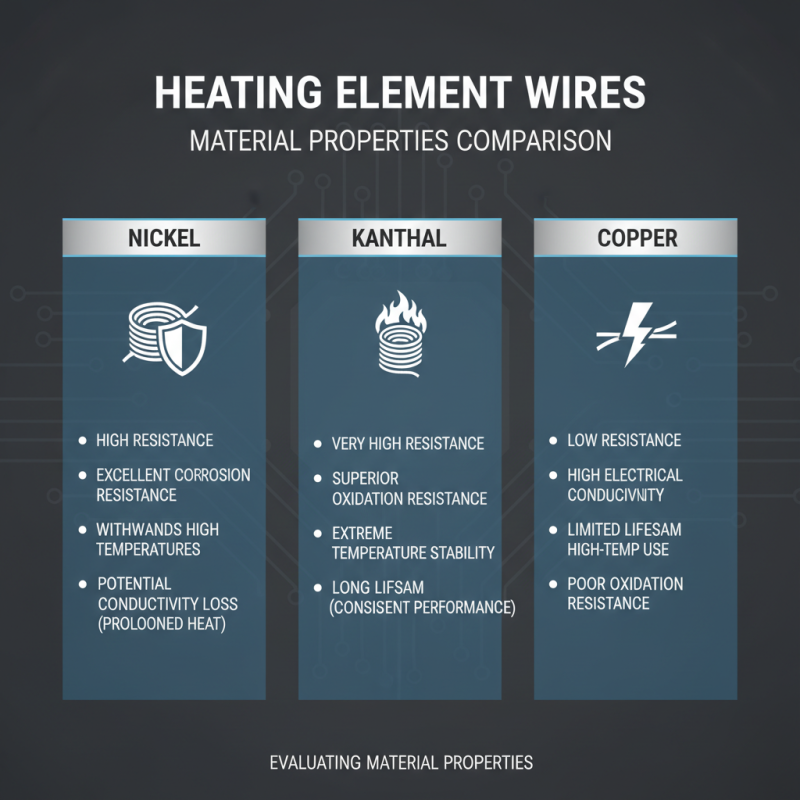
Evaluating Material Properties: Nickel vs. Kanthal vs. Copper
When evaluating heating element wires, material properties play a crucial role. Nickel wires, for instance, are known for their high resistance and excellent corrosion resistance. They can withstand high temperatures but may lose conductivity with prolonged exposure to heat. This can be a drawback for some applications requiring consistent performance over time.
Kanthal, a popular choice in heating applications, consists of iron, chromium, and aluminum. It offers high oxidation resistance and durability. Kanthal can handle immense temperatures without deforming. However, it might be less flexible, making it harder to work with for intricate designs. Users should consider the balance between flexibility and heat tolerance based on their specific project needs.
Copper wires are another option, known for their excellent conductivity. They heat up quickly and are generally easier to shape. However, copper has lower resistance, which can lead to inefficiencies in certain situations. Overheating can also be a risk if not monitored closely. Choosing the right wire often requires weighing these trade-offs carefully through testing and evaluation in real-world conditions.
Assessing Resistance and Wattage: Calculating Your Heating Needs
Choosing the right heating element wire is crucial for effective heating. Understanding resistance and wattage is essential to meet your heating needs. Resistance determines how much current passes through the wire. Lower resistance allows more current flow, resulting in greater heat. Calculating your requirements involves knowing your voltage source and desired wattage.
To find the right wire, use Ohm's Law: Voltage = Current x Resistance. If you're aiming for 100 watts at 120 volts, the necessary current is about 0.83 amps. You can find the required resistance by dividing voltage by current, which gives you roughly 145 ohms. This calculation guides your choice of wire gauge, as different gauges have varying resistances.
Addressing heating needs can be tricky. Sometimes, you might miscalculate, leading to insufficient or excessive heat. Reflect on your project's specifics. Consider safety aspects like the wire's heat tolerance. An overpowered element could pose a risk. Ensuring accuracy in calculations will save time and energy in the long run. Always be ready to reassess your choices as you gather more data from your project.
Application-Specific Considerations for Optimal Performance
When selecting a heating element wire, application-specific considerations are crucial. Different projects require distinct characteristics from the wire. For instance, some applications demand high resistance, while others benefit from high thermal conductivity. Understanding the environment in which the wire will operate is essential. High humidity or exposure to chemicals can deteriorate certain materials, leading to premature failure.
Thermal management also plays a vital role in performance. A wire must withstand the heat it generates without degrading. Assessing the wire's maximum operating temperature is important. Keeping the heating element within its thermal limits extends its lifespan and maintains efficiency. Inadequate temperature control might lead to fire hazards in extreme cases.
Additionally, the wire gauge influences heating efficiency. Thicker wires can handle more current, but they may require more space in applications with tight dimensions. Matching the wire size to the project's needs often takes trial and error. This process can be frustrating, but it ultimately leads to optimal project performance. Understanding these nuances helps avoid costly mistakes.
How to Choose the Right Heating Element Wire for Your Project?
| Application |
Material |
Diameter (AWG) |
Maximum Temperature (°C) |
Resistance (Ohms/m) |
| Industrial Heating |
Nichrome |
18 |
1200 |
0.099 |
| Home Appliances |
Copper |
20 |
800 |
0.081 |
| Medical Equipment |
Stainless Steel |
22 |
600 |
0.099 |
| Commerical Cooking |
Incoloy |
16 |
1000 |
0.060 |
| Automotive Heating |
Kanthal |
19 |
900 |
0.120 |

 +852 60984748