+852 60984748
Global buyers need more than a low supplier price when selecting a Portable Heat Plate. They need stable heating, safe materials, dependable controls, and clear documentation. A plate may look simple on a factory table, yet its performance depends on wattage, thermostat accuracy, surface durability, and internal insulation. Small details matter.
Elena Markovic, a thermal-appliance engineer and sourcing consultant, explains, “A dependable heat plate should deliver predictable heat before it delivers maximum heat.” Her observation reflects a practical purchasing lesson. A powerful unit is not automatically the best unit. Even heating can protect cookware and improve cooking consistency. A cool corner or unstable dial can quickly create complaints.
This guide reviews leading Portable Heat Plate suppliers for international buyers. It considers manufacturing experience, quality-control procedures, customization options, packaging, certifications, and export communication. Suppliers should provide test records, product specifications, and realistic delivery timelines. Clear evidence builds trust.
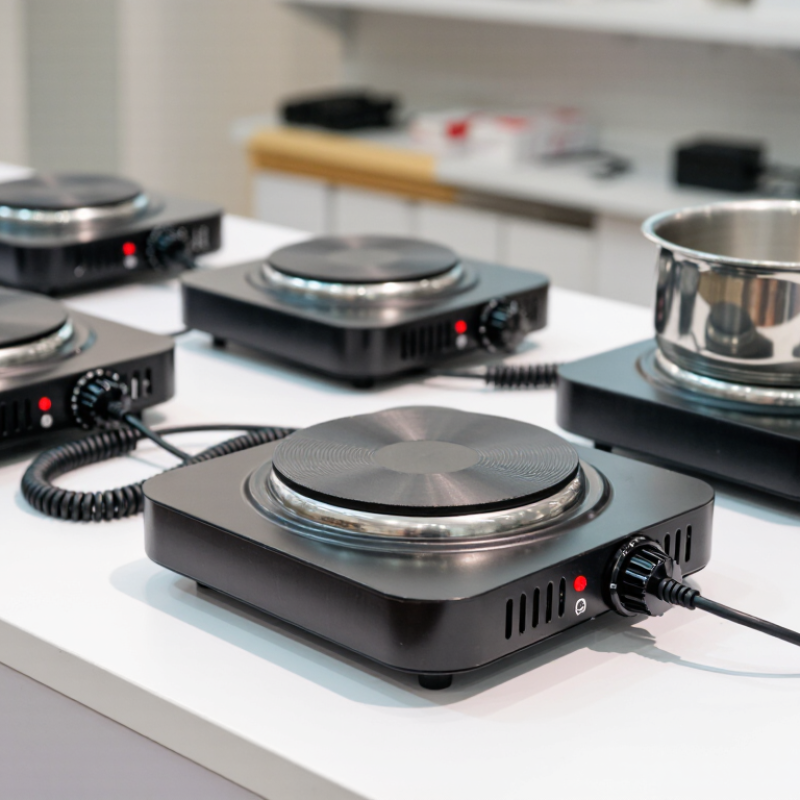
Look closely at the surface.
Buyers should also examine sample units under ordinary conditions. Test the plate with a pan, observe temperature recovery, and inspect the power cord. These steps reveal weaknesses that brochures often hide. Supplier rankings can help, but they are not perfect. Product quality may change between production batches, and regional electrical requirements can differ.
The strongest supplier is not always the largest. It is the one that combines consistent production, responsive support, and transparent technical information. Global sourcing involves uncertainty. Careful verification reduces it.
Portable heat plates serve buyers who need controlled cooking without a fixed installation. Common types include electric coil, ceramic radiant, and induction models. Coil plates are affordable and tolerate many cookware shapes. Ceramic surfaces heat more evenly, but they remain hot after shutdown. Induction plates respond quickly and require magnetic cookware. The U.S. Department of Energy reports that induction can be up to three times more efficient than gas cooking, making energy transfer a central buying factor.
Performance depends on more than wattage. A 1,500-watt unit suits small pots, sauces, and light commercial preparation. Higher-power models reduce heating time but may need stronger electrical circuits. Useful features include adjustable thermostats, overheat protection, automatic shutoff, timer controls, and a stable non-slip base. The ENERGY STAR cooking-product guidance also emphasizes efficient heat delivery and responsive controls. Buyers should check plug type, operating voltage, surface temperature, and replacement-part access before ordering.
Applications vary widely. Catering teams use portable plates for buffet service and mobile demonstrations. Laboratories may require precise, low-temperature heating, although cooking appliances are not always suitable for laboratory protocols. Small apartments benefit from compact ceramic or induction units during kitchen renovations. Outdoor users often prefer simple coil designs because they are less sensitive to cookware compatibility. Still, “portable” does not mean universally convenient. I have seen specifications overlook cable length and ventilation needs. Those small details can cause real delays. Temperature readings may also differ between the plate and the pan. Supplier testing should include actual cookware, repeated cycles, and local power conditions.
The chart compares representative rated power levels commonly found in portable electric heat plates. Higher wattage generally supports faster heating, while induction models typically provide more precise temperature control and improved energy transfer.
When comparing portable heat plate suppliers, start with heating performance, not glossy product photos. Ask for measured temperature range, warm-up time, surface uniformity, and power stability. A plate reaching 200°C is less useful if its center overheats cookware edges. Request test data from a repeatable method, such as a 1-liter water test at 23°C. Confirm whether readings come from the plate surface or the pan base. That small distinction changes purchasing decisions. Inspect the heating element, housing material, controls, and cord strain relief. Stainless steel may resist stains, while poorly sealed controls can collect moisture. Ask for sample units before placing volume orders. Test it yourself. Real testing reveals loose knobs, noisy fans, or unstable feet. Catalogs rarely show these details. Some suppliers answer quickly but avoid technical questions. Treat that as a warning sign, not a final verdict.
Reliability also depends on documentation and production control. Compare declared input voltage, plug configuration, rated load, thermal protection, and test records for each model. Global buyers should verify compatibility with local electrical requirements. Safety claims should be supported by current, traceable reports from competent laboratories. Check whether each report matches the exact model, not a similar-looking unit. Review factory quality procedures, incoming-material checks, final inspection, and batch traceability. Ask how defects are handled after delivery. Details matter here. A clear replacement process matters when a shipment contains cracked insulation or uneven heating. Compare minimum order quantities, sample fees, lead times, packaging strength, spare parts, and communication speed. Photograph packaging after a drop test if possible. I would not judge a supplier by the lowest quotation alone. That approach often misses hidden costs. Require written specifications, approved samples, and inspection points before production begins.
Portable heat plate sourcing depends on more than unit price. East Asian production centers often offer dense supplier networks, automated stamping, ceramic heating assembly, and high-volume testing. Southeast Asian factories can provide competitive labor costs and flexible assembly lines, though component sourcing may cross several borders. European manufacturers usually emphasize precision machining, thermal safety, and documented quality systems. North American suppliers may support faster regional delivery and custom engineering, but smaller production runs can raise costs.
Good capabilities are visible on the factory floor. Look for resistance-wire winding, insulated wiring, temperature-sensor calibration, and controlled surface finishing. A reliable supplier should show sample records, batch traceability, and test data for heat-up time, thermal stability, and electrical insulation. Ask whether testing covers the buyer’s intended voltage and plug configuration. It should. Some suppliers provide only a basic functional check, which may not reveal uneven heating near the plate edge.
Supplier maps can mislead. A factory listed in one region may import its key heater modules elsewhere. Request a process-flow sheet and verify where assembly, testing, and packaging occur. Pilot orders are useful. They expose weak documentation, inconsistent screw torque, or coating defects before larger commitments. Low minimum quantities do not always mean low risk; sometimes they reflect an immature process. Independent inspections add confidence, yet they cannot replace clear specifications and repeated production evidence. A reasonable assumption can still fail.
Top Portable Heat Plate Suppliers for Global Buyers
Quality Standards, Safety Certifications, and Product Testing
Reliable suppliers should provide more than attractive wattage and polished photographs. Ask for test reports covering IEC 60335-1 and IEC 60335-2-9 requirements. These standards address insulation, abnormal operation, temperature rise, and protection against electric shock. Independent laboratories should hold ISO/IEC 17025 accreditation. A certificate without laboratory details deserves questions.
Testing must resemble real kitchens. Inspectors should measure surface temperatures after prolonged use, check automatic shutoff performance, and test power cords through repeated bending. Tip-over testing also matters, especially for lightweight plates on crowded counters. NFPA reported an annual average of 158,400 U.S. home cooking fires from 2017 to 2021. Cooking equipment caused about 470 deaths and 4,150 injuries each year. Those figures make thermal protection practical, not decorative.
For international purchasing, request a CB Scheme report, national conformity documents, and a traceable production-batch record. Certification marks alone do not prove that every shipment matches the tested sample. I would also compare incoming inspection results, including insulation resistance and thermostat accuracy. One weakness remains: suppliers may show excellent laboratory results but weak factory controls. A small sample audit can reveal loose terminals, uneven heating, or thin insulation. Do not ignore these details. Safety paperwork should support hands-on evidence, not replace it.
| Supplier Profile | Typical Product Range | Common Electrical Configurations | Core Safety Standards to Request | Relevant Market Documentation | Recommended Product Testing | Key Safety Features | Quality-Control Evidence | Buyer Verification Points |
|---|---|---|---|---|---|---|---|---|
| Factory-direct OEM/ODM manufacturer | Single- and double-burner portable hot plates, cast-iron heating plates, solid heating elements, and thermostat-controlled models. |
110–120 V / 60 Hz
220–240 V / 50 Hz Typical rated power is approximately 1,000–2,000 W per unit, depending on the design. |
IEC 60335-1 for household and similar electrical appliances; IEC 60335-2-9 for portable cooking appliances, where applicable; applicable national deviations for the destination market. |
EU: CE marking supported by an EU Declaration of Conformity, applicable safety assessment,
EMC assessment, and RoHS compliance documentation. UK: UKCA requirements where applicable. North America: certification or evaluation accepted by the target authority. |
Dielectric-strength test, insulation-resistance test, leakage-current test, grounding-continuity test, abnormal-operation test, temperature-rise test, endurance test, and power-consumption verification. | Thermal fuse or thermal cut-out, insulated terminals, strain relief, stable non-slip feet, heat-resistant wiring, over-temperature protection, and an enclosure that limits access to live parts. | Incoming-material inspection, first-article approval, in-process checks, 100% basic electrical safety testing, final visual inspection, and lot-based reliability sampling. | Confirm the exact model number on all test reports; review critical-component ratings; verify production-site capability; approve a golden sample; and require corrective-action records for failed tests. |
| Audited contract manufacturer | Customized heat plates for retail, hospitality, laboratory-support, catering, and private-label applications with buyer-defined specifications. | Voltage, frequency, plug type, cord length, power rating, thermostat scale, indicator-light configuration, and packaging can usually be specified by the buyer. |
IEC 60335-1 and applicable Part 2 requirements; IEC 60529 only when an ingress-protection rating is specifically claimed; IEC 60320 or the relevant national standard for detachable appliance couplers, where used. |
Technical file, risk assessment, bill of materials, critical-component list, Declaration of Conformity, user instructions, traceability records, and market-specific labeling artwork. | Full-load heat distribution, surface-temperature measurement, control-cycle endurance, drop and mechanical-strength tests, cord-flexing tests, abnormal-use simulation, and packaging-transit testing. | Calibrated thermostat, heat-resistant housing, protected control knob, strain-relieved power cord, thermal protection, clear hot-surface warning, and mechanical stability during normal use. | Documented quality-management procedures, calibrated test equipment, batch traceability, inspection plans, nonconformance controls, and retained production samples. | Check whether the audit covers the actual manufacturing address; verify calibration certificates; confirm that test conditions match the final rated voltage, frequency, and power; and review change-control procedures. |
| Regional electrical-appliance distributor | Standard catalog models intended for domestic kitchens, student housing, temporary cooking areas, small offices, and hospitality use. | Usually supplied in the electrical configuration required by the local market; plug and labeling should match the destination country before shipment. | The applicable national adoption of IEC 60335 requirements, local electrical-safety rules, EMC requirements, and chemical restrictions relevant to the destination market. | Product label, user manual, importer or responsible-person information, conformity documentation, warranty terms, and traceability information. | Sample-based incoming inspection, functional heating test, visual inspection, cord and plug check, leakage-current test, and confirmation of rated input power. | Non-slip base, power indicator, temperature control, thermal cut-out, heat-resistant power cord, and instructions covering ventilation and hot-surface hazards. | Purchase-order inspection records, supplier certificates, warranty-return analysis, stock traceability, and documented handling of safety complaints. | Confirm that the distributor is authorized to supply the model; verify the responsible economic operator where required; inspect product markings; and check whether replacement parts are available. |
| Export-focused private-label supplier | Compact single-burner and double-burner units with customized colors, packaging, manuals, labels, and accessories for multiple countries. | Country-specific versions may include different plugs, cords, voltage ratings, frequency ratings, heating powers, and control markings. | Destination-specific conformity assessment based on the final product design; IEC 60335-1 and IEC 60335-2-9 are commonly used technical references for applicable portable cooking appliances. | Country-of-destination labeling, safety instructions in required languages, product identification, batch or serial traceability, Declaration of Conformity where applicable, and restricted-substance records. | Pre-shipment inspection, production-line electrical safety tests, packaging verification, label review, language review, and representative-sample testing at an independent laboratory. | Correct fuse or thermal protector selection, secure internal wiring, insulated live parts, stable support, visible power indicator, and warnings against unattended operation. | Approved artwork, packaging-control checklist, shipment inspection report, sample retention, production photographs, and corrective-action tracking. | Ensure that each voltage version has its own validated test evidence; confirm that packaging does not show unsupported certifications; and review the final production sample before shipment. |
| Specialty small-appliance supplier | Higher-duty portable heat plates for catering, buffet service, demonstration kitchens, mobile food service, and frequent-use environments. | Higher-wattage configurations may require dedicated circuits; the rated current must be compatible with the destination plug, socket, cord, fuse, and installation conditions. | Applicable household or commercial-appliance safety standard, IEC 60335-1 where relevant, destination-market electrical rules, and food-contact requirements only for components intended to contact food. | Safety test report, operating instructions, maintenance guidance, cleaning instructions, spare-part information, and service or warranty documentation. | Extended endurance testing, repeated thermostat cycling, high-temperature operation, cleaning-resistance assessment, mechanical-stability testing, and abnormal-operation testing. | Robust housing, protected heating element, thermal limiter, clear operating controls, cool-touch areas where claimed, non-slip feet, and safe cable routing. | Reliability test plan, service-failure analysis, component traceability, maintenance records, and documented inspection of high-temperature parts. | Confirm the intended duty cycle; review maximum surface temperatures; verify cleaning limitations; assess spare-part availability; and avoid treating a domestic rating as a commercial-use rating. |
| Compliance-focused sourcing partner | Multi-country sourcing programs covering product selection, supplier qualification, laboratory coordination, inspections, and shipment release. | Configuration is selected according to destination voltage, frequency, plug system, rated power, and applicable energy or labeling rules. | IEC 60335-1, applicable IEC 60335-2 requirements, EMC standards, RoHS Directive 2011/65/EU as amended by 2015/863, REACH obligations, and destination-country requirements. | Independent laboratory report, Declaration of Conformity where applicable, technical documentation, chemical-compliance declaration, packaging and label review, and inspection reports. | Risk-based testing covering electrical safety, EMC, abnormal operation, temperature rise, mechanical hazards, material compliance, and production consistency. | Safety design review, critical-component approval, thermal protection, protective earthing or double insulation as designed, and documented risk controls. | Supplier audit, pre-production inspection, during-production inspection, pre-shipment inspection, laboratory coordination, and corrective-action verification. | Confirm laboratory accreditation for the requested scope; ensure reports identify the exact model and ratings; verify report dates and test samples; and re-test after safety-related design changes. |

Selecting a portable heat plate supplier requires more than comparing unit prices.
Grand View Research reported that the global electric cooktop market was valued at approximately USD 21.8 billion in 2023. This growth attracts new factories, but production scale does not prove product reliability.
Ask suppliers for rated wattage, heating-time tests, surface-temperature limits, and component traceability. Request recent laboratory reports, not only factory-issued certificates.
Test samples under real conditions.
Place a 2-liter stainless-steel pot on the plate and record boil time, temperature recovery, cord heating, and control accuracy. Repeat the test after several hours of operation. Small differences can reveal weak thermal protection.
The International Energy Agency’s 2024 Global Energy Review reported that global electricity demand rose by about 4% in 2024. Energy efficiency should therefore be checked, even for compact appliances. A lower-wattage model may heat slowly, while excessive power can increase operating costs.
Supplier evaluation should also cover documentation and delivery discipline.
The World Bank’s 2023 Logistics Performance Index measures customs, infrastructure, shipment reliability, and timeliness. Use these categories when reviewing export capability.
Confirm minimum order quantities, spare-part availability, packaging tests, warranty response times, and production lead times. An on-site audit is useful, but it is not perfect. One visit may miss seasonal quality problems. Require batch records and random third-party inspections.
Some buyers focus too heavily on price; that mistake can become expensive after the first failed shipment.